An Open Invitation:
With your help, I hope to build a large collection of profiles on individuals with Asperger's Syndrome.
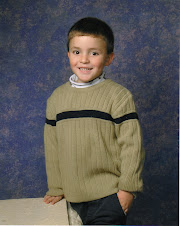
My nephew was diagnosed with Asperger's Syndrome about one year ago. He is now four years old. I have made this website to better understand him and to help others better understand Asperger's Syndrome. I am hoping that this questionnaire will help with both! Thank-you all in advance for your help!!
If you or someone you love has autism or Asperger's syndrome, I'd like to hear from you. Please try to answer the following questions as accurately as you can. Either e-mail your responses to me at "derin417670@aol.com or post your responses under comments on this post and I'll make a new post about you or your loved one as soon as I get a chance.
1) Are you answering these questions for a loved one with Asperger's Syndrome? If so, what is your relationship with him or her? Please provide your name(s) and location(s) in as much detail as you feel comfortable with. I would love it if you could include a photo, also!!
2) Please define Asperger's as concisely as you can. No dictionaries please; I'm looking for your understanding of the word. What would you like the world to know about Asperger's?
3.) When were you or your loved one born? Diagnosed with Asperger's Syndrome? Have there been any other diagnoses?
4) Please describe social skills of you or your loved one.
5.) Please describe linguistic or language skills.
6.) What sort of therapies have you or your loved one tried? Have they helped over time? If so, how? Please describe any medications and their effects as best you can recall.
7.) What are some of your or your loved one's biggest difficulties today?
8.) Have you or your loved one made any special achievements you'd like to mention?
9.) What have you learned from your experience with Asperger's? Have you formed a philosophy or taken away any life lessons?
10.) What has been the greatest challenge for you or your loved one? The greatest reward?
11.) Is there anything else you would like to add about your experiences with Asperger's?
Thank-you so much for your participation! Tell your friends about this site!! Colleen
Do You Have a Cute Kid?

Showing posts with label asperger's syndrome. Show all posts
Showing posts with label asperger's syndrome. Show all posts
Friday, January 4, 2008


Sunday, December 30, 2007
Sleep Problems in Children with Aspergers
Children With Asperger Syndrome More Likely To Have Sleep Problems
ScienceDaily (Nov. 21, 2007) — The first known attempt to evaluate the sleep patterns of children with Asperper Syndrome (AS), taking into account sleep architecture and the cyclic alternating pattern (CAP), finds that children with AS have a high prevalence of some sleep disorders and mainly problems related to initiating sleep and sleep restlessness together with morning problems and daytime sleepiness, according to a new study.
The study, authored by Oliviero Bruni, MD, of the Center for Pediatric Sleep Disorders at University La Sapienza in Rome, Italy, focused on eight children with AS, 10 children with autism and 12 healthy control children. The parents of the children with AS filled out the following materials:
Sleep questionnaire.
Pediatric Daytime Sleepiness Scale, which evaluates the relationship between daytime sleepiness and school-related outcomes.
Autism Diagnostic Observation Schedule, a semi-structured, standardized assessment of communication, social interaction and play or imaginative use of materials for individuals who have been referred because of possible autism spectrum disorders.
Child Behavior Checklist, a questionnaire used to examine daytime behavior in children.
In addition, the children took the Wechsler Intelligence Scale for Children, which measures verbal IQ, performance IQ and a full-scale IQ, and also underwent an overnight polysomnogram, or sleep study.
Several sleep parameters, such as time in bed, sleep period time, number of awakenings per hour, and sleep efficiency, were evaluated. CAP, a periodic EEG activity of non-REM sleep characterized by repeated spontaneous sequences of short-lived events (phase A) with the return to background activity identifying the interval that separates the repetitive elements (phase B), was also scored.
According to the results, 50 percent of the children with AS were reluctant to go to bed, while 75 percent felt a need for light or a television in the bedroom, 87 percent had difficulty getting to sleep at night and 75 percent fell asleep sweating. In addition, 50 percent felt unrefreshed when waking up in the morning, 87 percent had difficulty waking up in the morning and 87 percent felt sleepy during the day.
With respect to the CAP, in comparison to healthy controls, subjects with AS showed a lower total CAP rate in the first two sleep stages, but not in slow wave sleep. In addition, they showed an increased percentage of synchronized EEG patterns and a decreased percentage of desynchronized EEG patterns. Further, the duration of the A and B phases, and consequently the entire CAP cycle, was longer. Compared to the children with autism, AS subjects showed an increased CAP rate in slow wave sleep and a decrease in the second sleep stage. The duration of the A phases was longer, as well as the CAP cycle duration.
"This study showed peculiar CAP modifications in children with AS and represented an attempt to correlate the quantification of sleep EEG oscillations with the degree of mental ability or disability," said Dr. Bruni.
AS is one of several autism spectrum disorders (ASDs) characterized by difficulties in social interaction and by restricted and stereotyped interests and activities. AS is distinguished from the other ASDs in having no general delay in language or cognitive development. Although it is not mentioned in standard diagnostic criteria, there are frequent reports of motor clumsiness and atypical use of language.
It is recommended that children in pre-school sleep between 11-13 hours a night, school-aged children between 10-11 hours of sleep a night, and adolescents about nine hours a night.
The American Academy of Sleep Medicine (AASM) offers some tips to help your child sleep better:
Follow a consistent bedtime routine. Set aside 10 to 30 minutes to get your child ready to go to sleep each night.
Establish a relaxing setting at bedtime.
Interact with your child at bedtime. Don't let the TV, computer or video games take your place.
Keep your children from TV programs, movies, and video games that are not right for their age.
Do not let your child fall asleep while being held, rocked, fed a bottle, or while nursing.
At bedtime, do not allow your child to have foods or drinks that contain caffeine. This includes chocolate and sodas. Try not to give him or her any medicine that has a stimulant at bedtime. This includes cough medicines and decongestants.
Children are encouraged to inform their parents of any sleep problems they may have. Parents who suspect that their child might be suffering from a sleep disorder are encouraged to consult with their child's pediatrician or a sleep specialist.
The journal article, entitled, "Sleep Architecture and NREM Alterations in Children and Adolescents with Asperger Syndrome", was published in Sleep November 1, 2007.
Adapted from materials provided by American Academy of Sleep Medicine.
ScienceDaily (Nov. 21, 2007) — The first known attempt to evaluate the sleep patterns of children with Asperper Syndrome (AS), taking into account sleep architecture and the cyclic alternating pattern (CAP), finds that children with AS have a high prevalence of some sleep disorders and mainly problems related to initiating sleep and sleep restlessness together with morning problems and daytime sleepiness, according to a new study.
The study, authored by Oliviero Bruni, MD, of the Center for Pediatric Sleep Disorders at University La Sapienza in Rome, Italy, focused on eight children with AS, 10 children with autism and 12 healthy control children. The parents of the children with AS filled out the following materials:
Sleep questionnaire.
Pediatric Daytime Sleepiness Scale, which evaluates the relationship between daytime sleepiness and school-related outcomes.
Autism Diagnostic Observation Schedule, a semi-structured, standardized assessment of communication, social interaction and play or imaginative use of materials for individuals who have been referred because of possible autism spectrum disorders.
Child Behavior Checklist, a questionnaire used to examine daytime behavior in children.
In addition, the children took the Wechsler Intelligence Scale for Children, which measures verbal IQ, performance IQ and a full-scale IQ, and also underwent an overnight polysomnogram, or sleep study.
Several sleep parameters, such as time in bed, sleep period time, number of awakenings per hour, and sleep efficiency, were evaluated. CAP, a periodic EEG activity of non-REM sleep characterized by repeated spontaneous sequences of short-lived events (phase A) with the return to background activity identifying the interval that separates the repetitive elements (phase B), was also scored.
According to the results, 50 percent of the children with AS were reluctant to go to bed, while 75 percent felt a need for light or a television in the bedroom, 87 percent had difficulty getting to sleep at night and 75 percent fell asleep sweating. In addition, 50 percent felt unrefreshed when waking up in the morning, 87 percent had difficulty waking up in the morning and 87 percent felt sleepy during the day.
With respect to the CAP, in comparison to healthy controls, subjects with AS showed a lower total CAP rate in the first two sleep stages, but not in slow wave sleep. In addition, they showed an increased percentage of synchronized EEG patterns and a decreased percentage of desynchronized EEG patterns. Further, the duration of the A and B phases, and consequently the entire CAP cycle, was longer. Compared to the children with autism, AS subjects showed an increased CAP rate in slow wave sleep and a decrease in the second sleep stage. The duration of the A phases was longer, as well as the CAP cycle duration.
"This study showed peculiar CAP modifications in children with AS and represented an attempt to correlate the quantification of sleep EEG oscillations with the degree of mental ability or disability," said Dr. Bruni.
AS is one of several autism spectrum disorders (ASDs) characterized by difficulties in social interaction and by restricted and stereotyped interests and activities. AS is distinguished from the other ASDs in having no general delay in language or cognitive development. Although it is not mentioned in standard diagnostic criteria, there are frequent reports of motor clumsiness and atypical use of language.
It is recommended that children in pre-school sleep between 11-13 hours a night, school-aged children between 10-11 hours of sleep a night, and adolescents about nine hours a night.
The American Academy of Sleep Medicine (AASM) offers some tips to help your child sleep better:
Follow a consistent bedtime routine. Set aside 10 to 30 minutes to get your child ready to go to sleep each night.
Establish a relaxing setting at bedtime.
Interact with your child at bedtime. Don't let the TV, computer or video games take your place.
Keep your children from TV programs, movies, and video games that are not right for their age.
Do not let your child fall asleep while being held, rocked, fed a bottle, or while nursing.
At bedtime, do not allow your child to have foods or drinks that contain caffeine. This includes chocolate and sodas. Try not to give him or her any medicine that has a stimulant at bedtime. This includes cough medicines and decongestants.
Children are encouraged to inform their parents of any sleep problems they may have. Parents who suspect that their child might be suffering from a sleep disorder are encouraged to consult with their child's pediatrician or a sleep specialist.
The journal article, entitled, "Sleep Architecture and NREM Alterations in Children and Adolescents with Asperger Syndrome", was published in Sleep November 1, 2007.
Adapted from materials provided by American Academy of Sleep Medicine.
Friday, December 28, 2007
The Hidden Curriculum
The Hidden Curriculum
One important social skills area that has long been neglected is the hidden curriculum - the do's and dont's are not spelled out for everyday behavior, but somehow everyone knows about them, except children and youth with Asperger's.
The Hidden Curriculum includes skills, actions, modes of dress, and so on, that most people know and take for granted. Every school and every society has a hidden curriculum. This unspoken curriculum is the one that causes challenges and grief for those with Asperger's.
Examples of Hidden Curriculum Items:
1.) Do not tell the principal that if she listened better, more kids would like her.
2.) You should not have to pay students to be your friends.
3.) Do not talk to other kids in the classroom when the teacher is giving a lesson.
4.) When the teacher is scolding another student, it is not an appropriate time to ask the teacher a question.
5.) When you are with classmates you don't know very well and you are the center of attention, do not pass gas, pick your nose, or scratch a private body part.
6.) During a fire drill, go with your class to teh nearest exit. This is not the time to go to the bathroom or to ask to go to the bathroom.
7.)Do not tell classmates about all of the "skeletons in your parents' closet."
8.) Do not draw violent scenes in school.
9.) During a conversation, fact the speaker and position your body in that direction.
10.) Speak to teachers in a pleasant tone of voice because they will respond to you in a more positive manner.
11.) When your teacher gives you a warning about behavior and you continue the behavior, you are probably going to get in trouble. If you stop the behavior immediately after the first warning, you will probably not get into trouble.
12.) If one of your classmates tells you to do something you think might get you in trouble, you should always stop and think before acting. Friends do not ask other friends to do things that will get them in trouble.
13.) Not all teachers have the same rules for their class. Some teachers do not allow any talking unless you raise your hand. Others may allow talking if you are not disruptive or annoying other students. It is important to know the rules different teachers have for their classes.
Taken from:Myles, B.S. & Simpson, Rich. (2001). Understanding the Hidden Curriculum:An Essential Social Skill for Children and Youth with Asperger Syndrome. Intervention.
One important social skills area that has long been neglected is the hidden curriculum - the do's and dont's are not spelled out for everyday behavior, but somehow everyone knows about them, except children and youth with Asperger's.
The Hidden Curriculum includes skills, actions, modes of dress, and so on, that most people know and take for granted. Every school and every society has a hidden curriculum. This unspoken curriculum is the one that causes challenges and grief for those with Asperger's.
Examples of Hidden Curriculum Items:
1.) Do not tell the principal that if she listened better, more kids would like her.
2.) You should not have to pay students to be your friends.
3.) Do not talk to other kids in the classroom when the teacher is giving a lesson.
4.) When the teacher is scolding another student, it is not an appropriate time to ask the teacher a question.
5.) When you are with classmates you don't know very well and you are the center of attention, do not pass gas, pick your nose, or scratch a private body part.
6.) During a fire drill, go with your class to teh nearest exit. This is not the time to go to the bathroom or to ask to go to the bathroom.
7.)Do not tell classmates about all of the "skeletons in your parents' closet."
8.) Do not draw violent scenes in school.
9.) During a conversation, fact the speaker and position your body in that direction.
10.) Speak to teachers in a pleasant tone of voice because they will respond to you in a more positive manner.
11.) When your teacher gives you a warning about behavior and you continue the behavior, you are probably going to get in trouble. If you stop the behavior immediately after the first warning, you will probably not get into trouble.
12.) If one of your classmates tells you to do something you think might get you in trouble, you should always stop and think before acting. Friends do not ask other friends to do things that will get them in trouble.
13.) Not all teachers have the same rules for their class. Some teachers do not allow any talking unless you raise your hand. Others may allow talking if you are not disruptive or annoying other students. It is important to know the rules different teachers have for their classes.
Taken from:Myles, B.S. & Simpson, Rich. (2001). Understanding the Hidden Curriculum:An Essential Social Skill for Children and Youth with Asperger Syndrome. Intervention.
Subscribe to:
Posts (Atom)